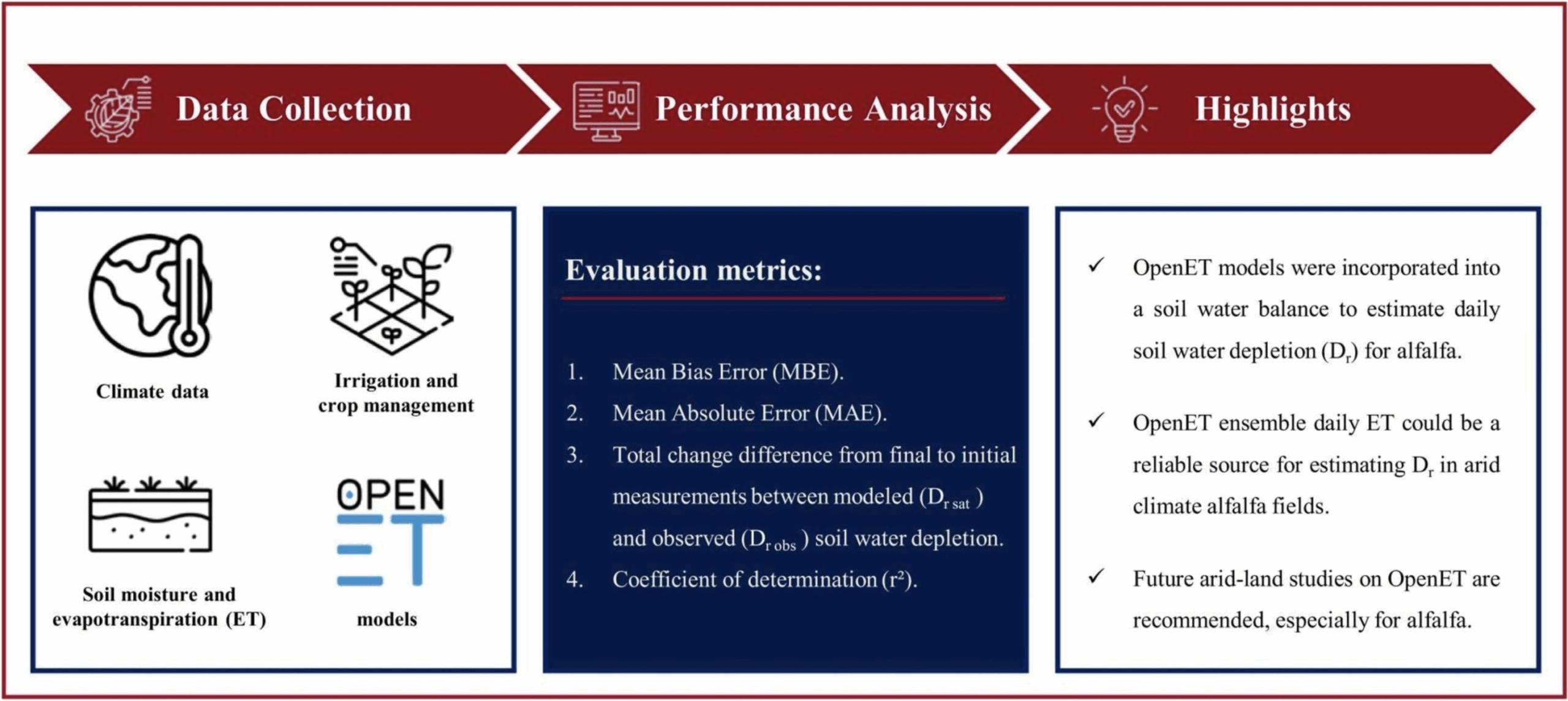
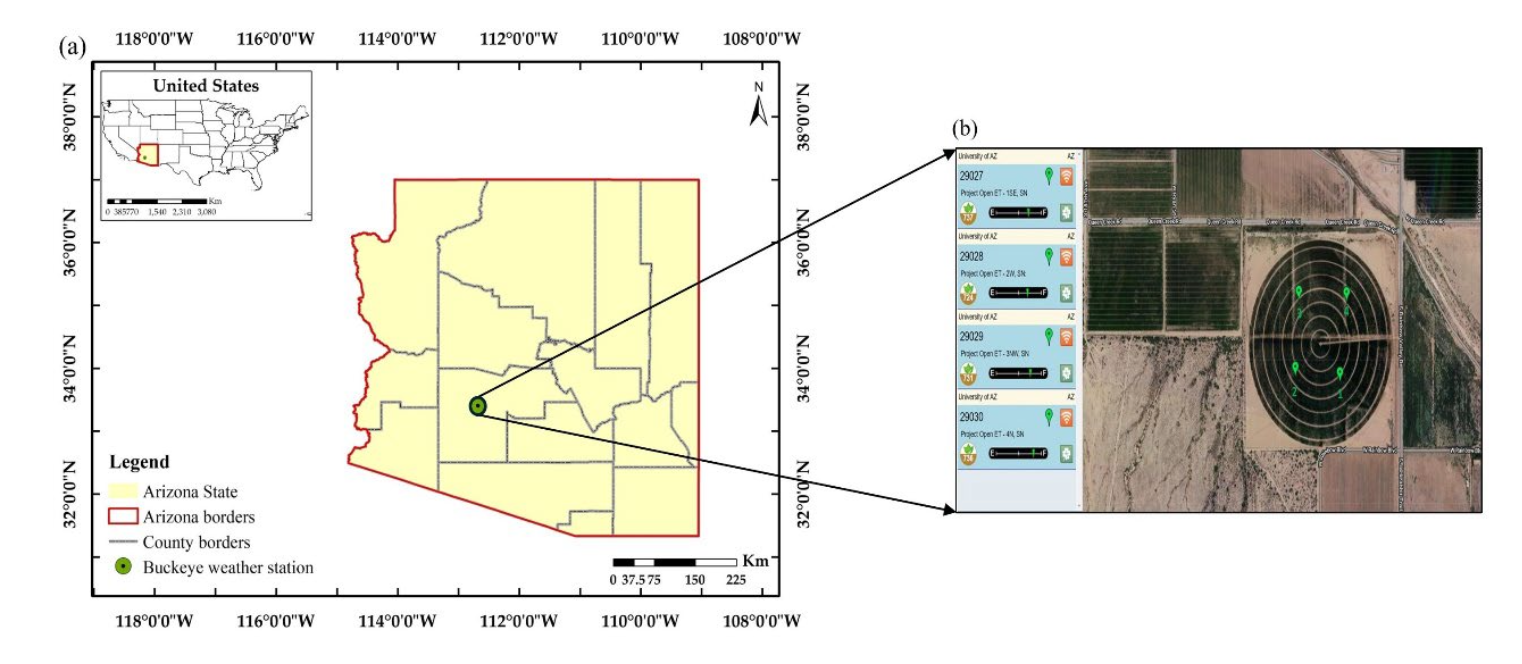
This study was conducted to evaluate six satellite-based ET models (ALEXI/DisALEXI, eeMETRIC, geeSEBAL, PT-JPL, SIMS, and SSEBop) and their Ensemble, derived from the OpenET platform, in estimating the actual evapotranspiration (ET) of alfalfa. Then, identify the best-performing OpenET model for alfalfa irrigation management under arid climate conditions in Arizona, USA. Five statistical metrics, the index of agreement (Dindex), Nash-Sutcliffe efficiency coefficient (NSE), mean bias simulation error (MBE), prediction/simulation error (Pe), and coefficient of determination (R2), were used to evaluate the seven alternative estimates in comparison with measured ET (ETmea) at a field scale with four replicates during the 2023 alfalfa growing season in Buckeye, Arizona. Overall, OpenET models and their Ensemble were linearly correlated to average ETmea with R2 > 0.71. Our findings showed that ALEXI/DisALEXI, geeSEBAL, and PT-JPL had a general tendency to underestimate actual ET with acceptable to poor prediction errors (Pe ≤ -35.18 for PT-JPL). In contrast, eeMETRIC, SIMS, and SSEBop overestimated ETmea with acceptable to poor prediction errors (1.86 ≤ Pe ≤ 28.39). Our results highlighted the limitations of using the PT model in arid to semi-arid areas, even after the PT-JPL aridity correction. The Ensemble approach, which combined all OpenET models, showed a high degree of agreement (0.93 ≤ Dindex ≤ 0.96) with the ETmea of alfalfa during the growing period in 2023. R2 ranged from 0.77 to 0.86,
with positive NSE values between 0.67 and 0.82. Moreover, the Ensemble approach had significantly lower prediction errors
(-6.92 ≤ Pe ≤ 4.04) when compared with six OpenET models, making it the best to simulate alfalfa’s actual evapotranspiration
over the study area. This will contribute to providing farmers and decision-makers with the best satellite-based approach for
efficient irrigation management and water use in arid regions.
Estimating irrigation consumptive use for the conterminous United States: coupling satellite-sourced estimates of actual evapotranspiration with a national hydrologic model
Irrigation consumptive use is crucial information for water resource management